Executive Summary
When building a startup, your brand name, logo, or tagline is often your most valuable asset. It is how customers identify your quality and vision. However, failing to legally secure your brand identity early on can leave you vulnerable to copycats or accident...
When building a startup, your brand name, logo, or tagline is often your most valuable asset. It is how customers identify your quality and vision. However, failing to legally secure your brand identity early on can leave you vulnerable to copycats or accidental infringement lawsuits. Registering a trademark gives you exclusive ownership rights throughout India, enabling you to use the protected ® symbol with confidence.
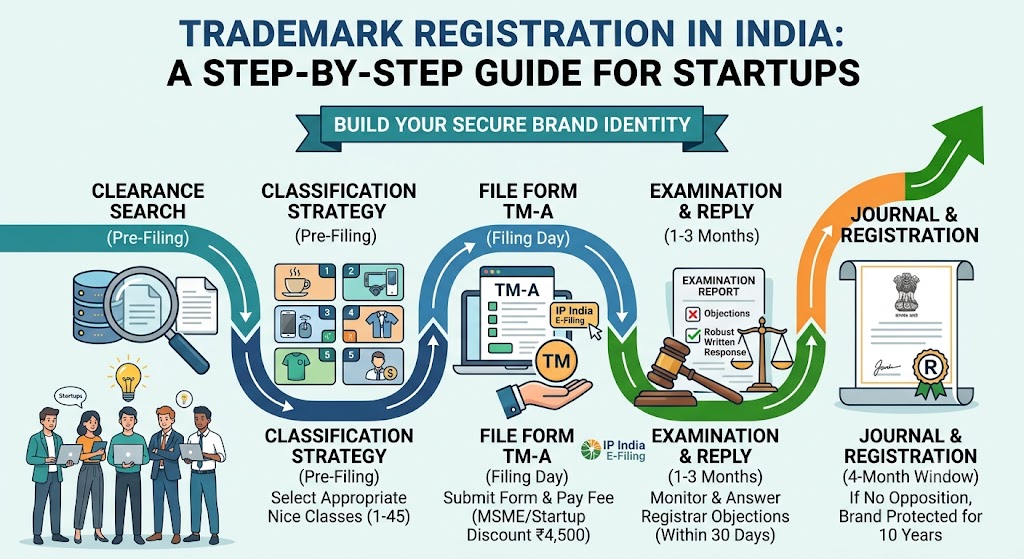
Filing a trademark on the official IP India portal involves a clear procedural pipeline. Navigating these legal milestones correctly saves your business significant time and cost.
The Trademark Registration Pipeline
1.Conduct a Comprehensive Clearance Search:Pre-Filing Stage.
Before submitting an application, you must search the official Government Trademark Registry database. This step checks for any phonetically or visually similar marks in your business class. Even if your spelling is different (e.g., "Kool" vs "Cool"), existing phonetic similarities can trigger immediate relative objections.
2.Determine Your Nice Classification Strategy:Pre-Filing Stage.
India follows the international Nice Classification system, which divides all goods and services into 45 distinct classes. You must strategically select the specific classes that map directly to your current business model and future expansion plans to avoid gaps in your protection.
3.File Form TM-A Online:Filing Day.
The formal application is submitted via the IP India e-filing portal. For individual proprietors, DPIIT-recognized startups, and small enterprises (MSMEs), the standard government filing fee is strictly subsidized at ₹4,500 per class, compared to ₹9,000 for large corporate entities. Once filed, you are legally permitted to use the ™ symbol.
4.Monitor and Reply to the Examination Report:1 to 3 Months Post-Filing.
The Trade Marks Registry will examine your application against absolute grounds (lack of distinctiveness) and relative grounds (existing conflicts). If the Registrar raises objections, you have an absolute, non-extendable deadline of 30 days to file a robust, legally structured written response. Failing to reply within this window causes the application to be abandoned automatically.
5.Journal Publication and Registration:4-Month Window.
If the response is accepted, or if no objections are found, the mark is advertised in the official Trademark Journal. This opens a 4-month window during which the public can file an opposition. If no opposition is received, a digital Registration Certificate is issued, protecting your brand for 10 years, renewable indefinitely.
A Note for Founders: Protecting your brand is a business decision with legal consequences. A strategic filing ensures you do not waste years building equity in a brand name you do not actually own.